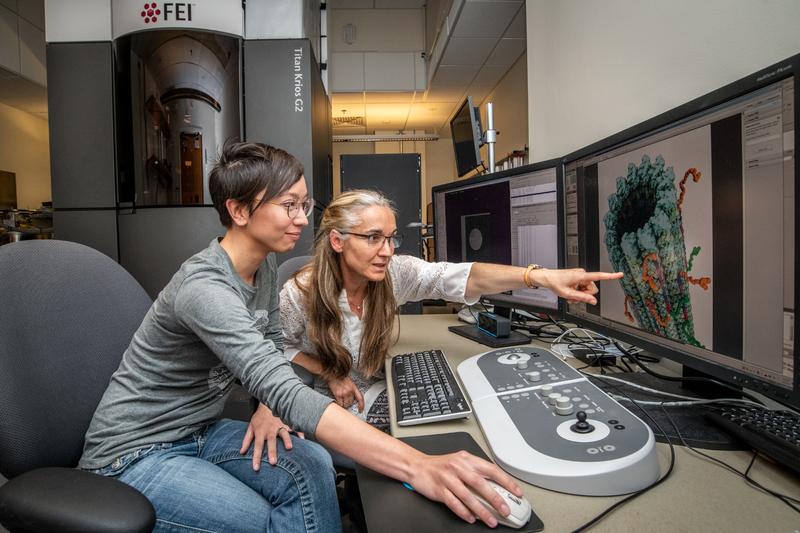
Researchers at Michigan State University (MSU), UC Berkeley, the University of Southern Bohemia, and Lawrence Berkeley National Laboratory (Berkeley Lab) have helped reveal the most detailed picture to date of important biological “antennae.”
The supply of a plant-derived anti-cancer drug can finally meet global demand after a team of scientists from Denmark and the U.S. engineered yeast to produce the precursor molecules. Previously, obtaining one gram of the chemotherapy drug required growing and harvesting 500 kilograms of the native plant’s leaves.
Using a new technique, physicists studying energetic collisions in light nuclei found something surprising: protons collide with their fellow protons and neutrons with their fellow neutrons more often than expected. Understanding these collisions is important for interpreting data in a wide range of physics experiments studying elementary particles.
A new solar material developed by Berkeley Lab scientists offers a simpler and more sustainable approach to solar cell manufacturing. The material’s lead-free formulation could also benefit the commercialization of perovskites, a promising solar material that requires much less energy to manufacture than silicon.
A team led by Berkeley Lab’s Ting Xu has developed a fully recyclable and biodegradable printed circuit. The advance could divert wearable devices and other flexible electronics from landfill, and mitigate the health and environmental hazards posed by heavy metal waste.
A new study on rubisco, a photosynthetic enzyme thought to be the most abundant protein on the planet, shows that proteins can change their structural arrangement with surprising ease. The findings reveal the possibility that many of the proteins we thought we knew actually exist in other, unknown shapes.
Researchers at Berkeley Lab recently unveiled a new, fast, and readily reproducible way to map and identify defects in two-dimensional materials. The method could dramatically reduce the time required to characterize two-dimensional materials and use them in next-generation quantum and electronic devices.
Take a deep dive into photosynthesis. Hear fascinating details they didn’t teach you in school and get a crash course on how natural photosynthesis inspires the development of renewable energy technologies that could someday replace all petroleum products.
Research at Berkeley Lab starts with basic science which leads to innovative breakthroughs that have changed the world. The Basics2Breakthroughs video series focuses on early career scientists discussing their research and what they hope for the future in that research.