While hydrogen is often talked about as a pollution-free fuel of the future, especially for use in fuel cell electric vehicles, hydrogen can be used for much more than zero-emission cars. In fact, from enhancing the flexibility of the grid to greening agriculture, hydrogen could play a major role in a clean and resilient energy system.
A new type of “bijel” created by Berkeley Lab scientists could one day lead to applications in soft robotics, liquid circuitry, and energy conversion. Bijels hold promise as a malleable liquid that can support catalytic reactions and electrical conductivity, among other functions, but before this new work at Berkeley Lab, they had been notoriously difficult to make.
Berkeley Lab scientists have developed a new electrocatalyst that can directly convert carbon dioxide into multicarbon fuels and alcohols using record-low inputs of energy. The work is the latest in a round of studies tackling the challenge of creating a clean chemical manufacturing system that can put carbon dioxide to good use.
In a big step toward sun-powered fuel production, scientists at Berkeley Lab have used artificial photosynthesis to convert carbon dioxide into hydrocarbons at efficiencies greater than plants. The achievement marks a significant advance in the effort to move toward sustainable sources of fuel. 
A new Lab-led study provides insight into how an ultrathin coating can enhance the performance of graphene-wrapped nanocrystals for hydrogen storage applications. The findings could help researchers understand how similar coatings could also enhance the performance and stability of other materials that show promise for hydrogen storage applications.
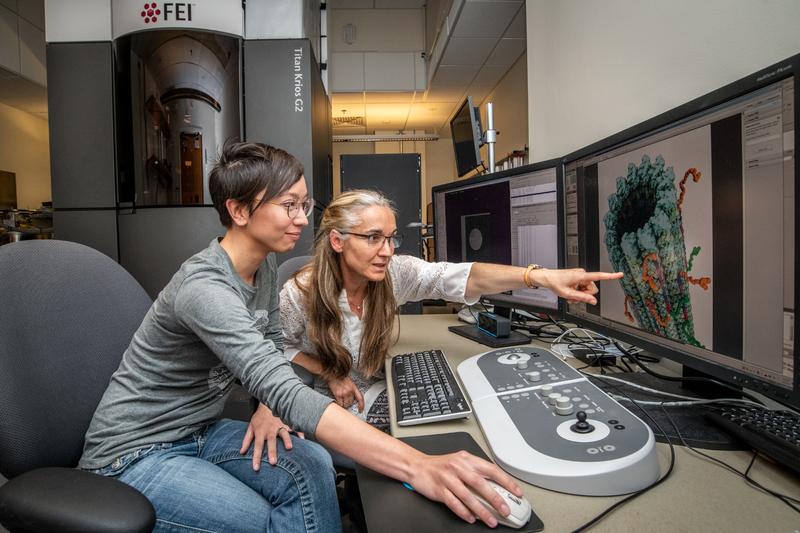
Using cryo-electron microscopy (cryo-EM), Berkeley Lab researchers have obtained 3-D models of a human transcription factor at near-atomic resolutions. The protein complex is critical to gene expression and DNA repair, and could aid research in targeted drug development.  
Berkeley Lab scientists have discovered the details of an unconventional coupling between a bacterial protein and a mineral that allows the bacterium to breathe when oxygen is not available. The research could lead to new innovations, such as sensors that can diagnose disease or detect contaminants.
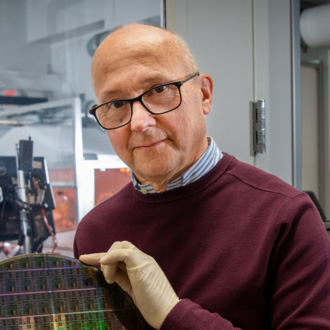
Lab researchers have developed a new method of analyzing the molecular-scale structure of organo-lead halide perovskites, a promising class of materials that could energize the solar cell industry.
New theories and 3-D simulations help explain what’s at work in the mysterious jets of energy and matter beaming from the center of galaxies at nearly the speed of light. As much as half of the jets’ energy can escape in the form of X-rays and stronger forms of radiation. Two different mechanisms serve to reduce about half of the energy of these jets.
The researchers were selected by the Department of Energy’s Office of Science to receive significant funding for research through its Early Career Research Program. The program bolsters the nation’s scientific workforce by providing support to exceptional researchers during the crucial early career years, when many scientists do their most formative work.